
James | The Lingering Doubts Behind Mid-Career Pivots
This story was originally published on Rice Media.
James Lai was walking past a McDonald’s near his family home in Bukit Merah when he asked himself: “Am I okay working here?”
Behind him were years of failed marketing ventures, entrepreneurial attempts, and poor investment decisions that left him financially strained. His marriage fell apart, and James moved back into the home he grew up in. He was in his 40s.
He went into the McDonald’s outlet and applied for a job.
In his teens, James scored well enough for his A-levels to get into the National University of Singapore. Then he turned it down because Toy Story had just come out, and he wanted to make cartoons instead. He worked a couple of odd jobs before he took an animation course in Kuala Lumpur in the 2000s.
Then he got his wish, working as a layout artist and animator on some Ben 10 direct-to-video films and a local animated CGI series called Dream Defenders, before leaving the industry for good in 2014. He had just gotten married, and the relatively modest income available in the animation industry made him question whether it could provide the stability he wanted for the future.
What followed was several years of drifting through multi-level marketing schemes, entrepreneurial ventures, trading, and investments. Some of his financial decisions left him increasingly in debt—at times, he borrowed money from relatives and in-laws to keep going.
Eventually, he reached a point where he realised that continuing down the same path wasn’t going to solve the problem. The financial strain weighed heavily on him, and his marriage eventually broke down.
“I still feel guilty about it,” says James, now 48.
In the aftermath, he moved back into his parents’ flat during the COVID years. That period eventually led him to McDonald’s, where he spent about two years working alongside what he affectionately calls the “down-to-earth, very nice aunties”.
As a batch cook, the work was physical. He hauled frozen stock, cleared bags of rubbish, and spent long shifts operating grills and fryers. Yet James found something there that had been missing from his life for years: mental space.
After years of uncertainty, the pause gave him room to reset. It also gave him time to think seriously about what he wanted to do next.
James had always been interested in technology. He was not entirely new to computers or IT, having had some earlier exposure to technical support and years of tinkering with computers and web technologies.
While working at McDonald’s, he began taking his interest more seriously by taking night classes in cybersecurity—an experience that convinced him that pivoting into the IT industry was not as far-fetched as he thought.
But cybersecurity was only the beginning; he knew he needed deeper and more practical skills.
Next came a subsidised three-month course in Cloud Support and DevOps Engineering, part of the SkillsFuture Career Transition Programmes that Temasek Polytechnic runs with the non-profit organisation Generation Singapore.
The programme equips learners from varied backgrounds with practical skills for related tech roles. With up to 95 percent of the course fee funded by SkillsFuture and a monthly training allowance for Singaporean citizens above 40, it gave James the financial freedom to start anew.
Trainers were cognisant of their students’ anxieties, James says, but they kept returning to an idea.
“They always want to stress that we are mid-career switchers; we are not coming in from zero. We can tap into our past experience and use it to differentiate ourselves.”
For James, that idea became important—everything he’d done before wasn’t irrelevant. Years of working with customers, technology, creative production, setbacks, and different environments gave him experience younger entrants might not have.
To combine that experience with demonstrable technical skills, he built a home lab in his old bedroom. Using his own equipment, James created an environment where he could practice working with servers, networking, and other infrastructure technologies outside the classroom.
At a job fair, James noticed a change in himself. He found himself speaking confidently about what he had built and the technical problems he had worked through. The interviewers were assured that he was a safe bet, even though he was a forty-something with no real resumé in tech.
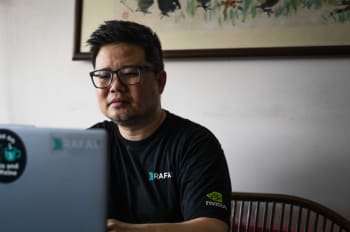
The career switch paid off. Today, James works as an Implementation/DevOps Engineer at Rafay (Asia) Pte. Ltd., supporting infrastructure for modern cloud and AI environments. He may be entrenched at the forefront of a new technology, but he knows it’s his responsibility to keep learning.
“I also cannot help wondering, because of AI, how long this will last,” he contemplates. The skills that helped him enter the industry will not necessarily be enough for the rest of his career.
But it no longer frightens him quite as much—after years of trying to find a direction, he now has one. After once reaching a point where he felt he had little left to lose, James has something worth building on again.